Furniture is one of those things that is easy to underestimate until you need to move it.
A dining table that looks perfectly ordinary in the kitchen suddenly needs four people, a moving blanket and a plan. A sofa fits the living room beautifully but barely clears the hallway. And a mattress that seemed manageable on its bed frame becomes a surprisingly awkward object to protect.
Now add a Northern Michigan winter.
Whether you're remodeling a house in Charlevoix, clearing out a seasonal cottage near Lake Charlevoix, downsizing or waiting for a closing date, storing furniture properly matters just as much as choosing the right storage unit. Wood, fabric, leather and mattresses all have different needs.
Here's how to prepare furniture for storage, avoid the mistakes that cause damage and choose a practical local storage option without renting more space than you need.
Already know you need room? Compare current furniture-storage unit sizes, prices and availability in Charlevoix.
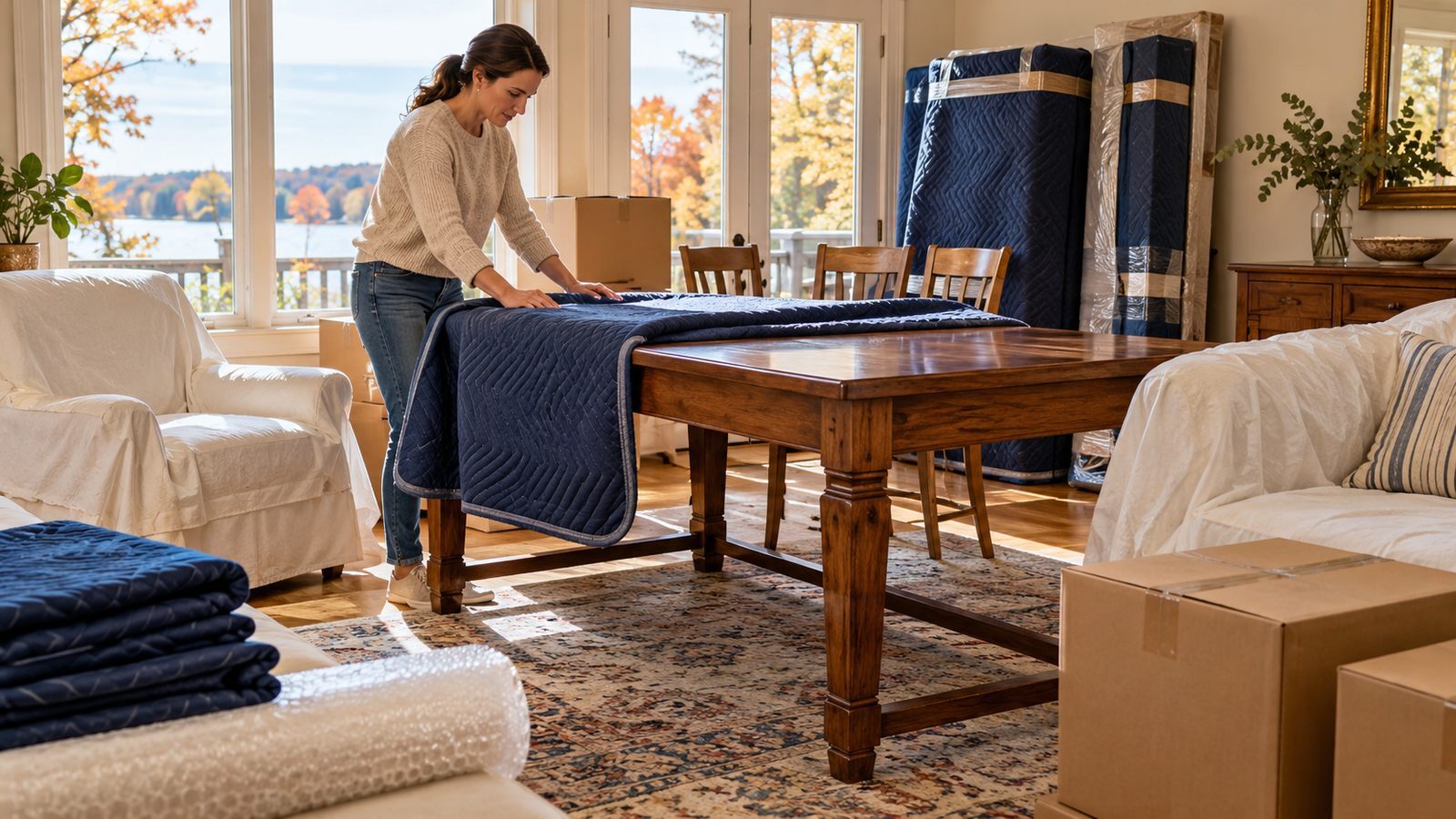
Cardboard boxes are relatively simple. They have flat sides, stack neatly and usually contain things that can be wrapped individually.
Furniture is less forgiving. A heavy box placed on a sofa can leave a permanent-looking impression. A table leg can loosen during a move. A damp cushion packed away in a sealed cover can develop an unpleasant surprise by spring.
In the Charlevoix area, storage may span humid summer weather, freezing winter temperatures or both. That doesn't mean every chair requires climate control. It means you should match the preparation and storage environment to the furniture you're keeping.
Solid-wood dining tables, dressers, cabinets and inherited furniture deserve extra attention. Wood responds to its environment, and significant changes in temperature and moisture can affect finishes, joints and the wood itself.
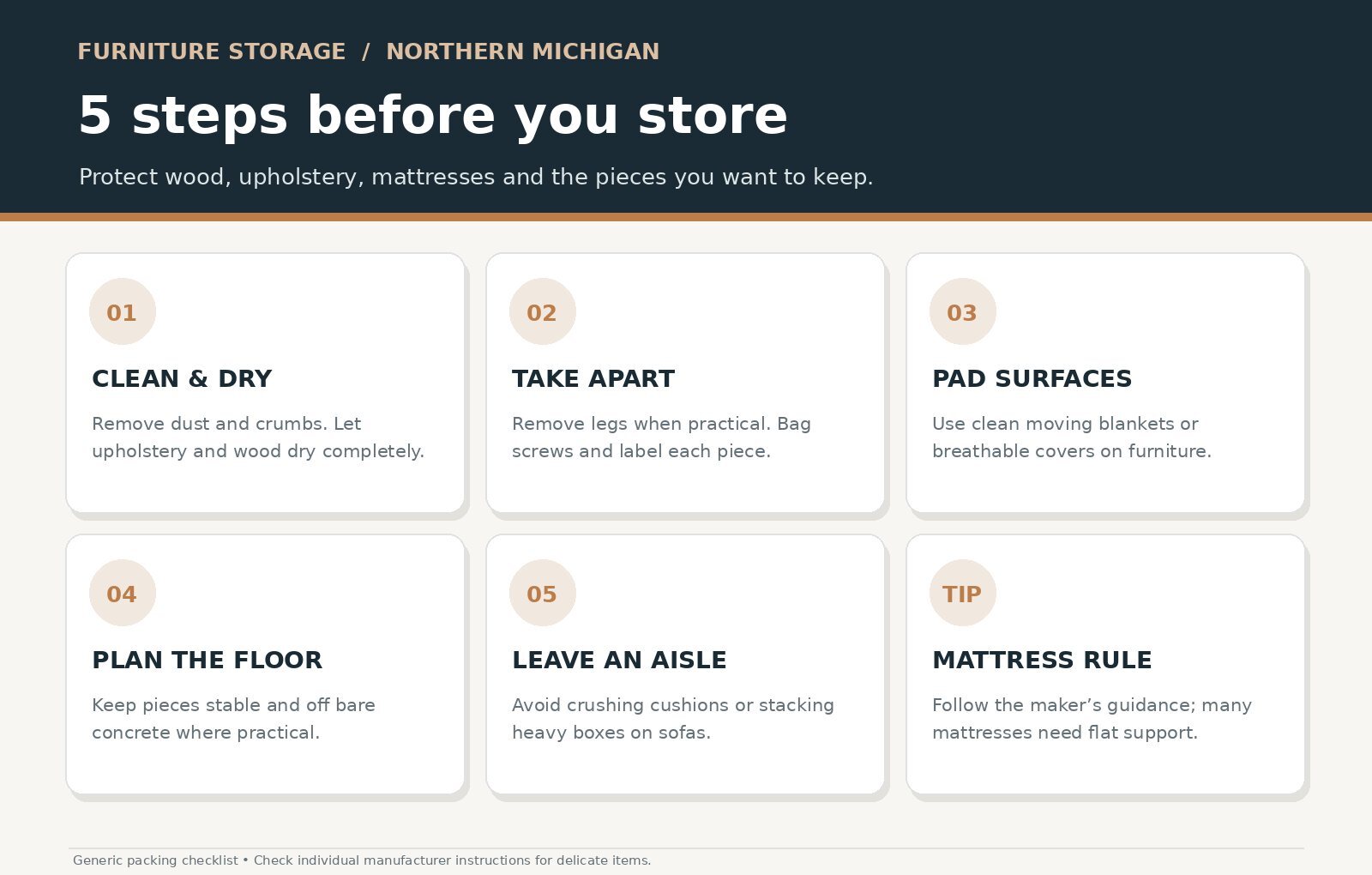
Start by removing dust and cleaning the piece using products appropriate for its finish. Let it dry fully. If the legs can be removed safely, wrap them separately and keep the hardware with the furniture.
Protect finished surfaces with clean, soft, breathable material. Avoid wrapping wood tightly in plastic for months at a time, particularly when moisture could become trapped. Don't stack heavy boxes on a tabletop or use a delicate dresser as a makeshift shelf.
For antiques, heirlooms or furniture that would be expensive to repair, climate-controlled storage at US-31 South Business Park is worth considering. If a piece needs a particular humidity range, ask about the actual conditions provided rather than assuming every climate-controlled unit is humidity-controlled.
Upholstery needs two things before storage: cleanliness and dryness.
Vacuum beneath removable cushions and along seams. Deal with spills or stains well ahead of moving day so the material has time to dry completely. If cushions come off, keep them together with the sofa, but don't crush them under heavy belongings.
Use clean furniture blankets or a suitable breathable cover to limit dust exposure. A tightly sealed plastic wrap can trap moisture against fabric or leather if the piece wasn't completely dry.
Leather furniture deserves care appropriate to the manufacturer's finish. Avoid applying random oils or conditioners immediately before storage. For longer storage periods, a more stable indoor environment may be a better choice than an unconditioned unit.
Most importantly, don't use the sofa as a platform for heavy boxes. The few square feet you save are rarely worth risking its frame or cushions.
This is one of the most common furniture-storage questions, and the answer depends on the mattress.
For many modern foam and hybrid mattresses, flat, level support is the safer long-term approach. Leaving a mattress on its side for an extended period may deform internal materials. Some manufacturers are explicit: Tempur-Pedic instructs owners to store its mattresses flat, not on their side or folded.
Check the care instructions for your particular mattress rather than assuming that standing every mattress against a wall is acceptable.
Before storage, make sure the mattress is clean and completely dry. Use an appropriate mattress cover, keep it off a dirty floor and avoid piling boxes or furniture on top. A mattress needs more usable floor area when stored flat, so account for that when selecting a unit.
Sometimes furniture is damaged before it even reaches storage.
Measure the doorway and the route from the room to the vehicle. Remove detachable table legs and bed-frame components when practical. Wrap mirrors and glass separately with materials designed for fragile items.
For dressers, empty drawers before lifting. Secure loose parts for transport, but don't apply tape directly to finished wood. Put hardware in a labeled bag so the next person assembling the furniture doesn't have to search six boxes for four bolts.
If you are moving a particularly large or heavy piece, ask about the unit's doorway dimensions before reserving. Floor area alone does not tell you whether an oversized cabinet will fit through the entrance.
The right choice depends on the material, value and expected length of storage.
Standard drive-up storage may be suitable for sturdy, properly prepared furniture during a relatively short move or project. Its major advantage is easy loading: you can pull a suitable vehicle close to the unit door rather than carrying a sofa through an interior hallway.
Climate-controlled storage is worth considering for solid wood, antiques, leather, delicate upholstery, certain mattresses and furniture being stored through multiple Northern Michigan seasons. It provides a more moderated indoor environment, although it does not replace proper packing or guarantee specific humidity levels.
Charlevoix Mini Storage offers drive-up units at US-31 South and Old Norwood Road, plus interior climate-controlled options at US-31 South Business Park. Larger premium climate-controlled units are offered at Stover Road, but availability is typically very limited.
For a broader explanation of storage environments, read our climate-controlled versus standard storage guide.
Start with the actual pieces you plan to store, not just the number of rooms they came from. A large sectional can take up more usable space than several small pieces of furniture. A mattress that needs to remain flat changes the layout too.
Approximately 50 square feet. A useful starting point for a small chair, side tables, boxes and other compact belongings. The listed rate is $60 per month for a 5 x 10 at Charlevoix Mini Storage, although some versions are currently waitlisted.
Approximately 100 square feet. Often a better fit when you're storing a sofa, dresser, bed-frame components and several boxes. The listed drive-up rate is $89 per month.
Approximately 150 square feet. A practical option when a renovation or move involves larger pieces and you need room to organize them. Listed drive-up pricing is $129 per month.
Approximately 200 square feet. Useful when you're storing a substantial combination of sofas, tables, beds, dressers and moving boxes. Listed drive-up pricing is $169 per month.
For customers who need climate control, the Business Park currently lists a specialty 18 x 9.5 dual-access climate-controlled unit at $250 per month, subject to availability. Other climate-controlled sizes may be waitlisted.
Prices and inventory above are from the online rental listings reviewed October 20, 2026. They can change at any time. Use the live rental page to confirm what's available before making plans, and check the storage unit size guide for more examples.
Think of the unit as a small room you may need to navigate again, not a space to fill blindly.
And remember that furniture must be completely dry before it is stored. A more expensive unit cannot undo moisture trapped inside a cushion or wrapped against a wooden surface.
Moving day in Charlevoix can involve snow, slush and wet boots. The key is to keep that moisture away from furniture before the unit is closed.
Have moving blankets and suitable covers ready before you start loading. Keep pieces out of snowbanks and puddles, and avoid setting upholstered furniture directly on wet ground. If something gets damp during transport, dry it thoroughly before leaving it in storage.
Both US-31 South and Old Norwood Road offer drive-up storage, which can shorten the distance between your vehicle and the unit. Customers have 24/7 access to their rented spaces, although office hours are separate and weather can still affect travel and loading conditions.
Sometimes furniture needs to leave the house for only a few weeks. Sometimes a simple project takes longer than expected.
If you're remodeling, moving furniture out of the work area can reduce repeated lifting and exposure to construction dust. Our home renovation storage guide explains how to plan that transition.
If you're selling a property, removing excess furniture can make rooms easier to photograph and show. See our Charlevoix home-staging storage guide for a practical approach to pre-packing before listing.
And if you're between homes, a separate storage space can give you time to move furniture into the next house in a sensible order rather than unloading everything at once.
Even a modest furniture collection can represent a meaningful replacement cost. Review any applicable homeowners or renters coverage rather than assuming that belongings stored away from home are automatically protected.
Charlevoix Mini Storage offers optional tenant protection plans. Review the coverage limits, exclusions and current terms before choosing a plan.
Many durable, properly prepared pieces can be stored in a standard unit, especially for shorter periods. For solid wood, leather, delicate upholstery, antiques and long-term storage, consider whether a more stable climate-controlled environment would be a better fit.
Use protective materials appropriate for the item. Moving blankets and breathable furniture covers are often useful for wood and upholstery. Avoid sealing damp furniture in plastic, which can trap moisture. Follow the manufacturer's care instructions.
Not every mattress should. Some manufacturers specifically require flat storage and warn against leaving a mattress on its side. Check the instructions for your model and allow enough floor space if it must remain flat.
A 10 x 10 is often a useful starting point for a couch plus some additional furniture or boxes, but the exact fit depends on the couch's dimensions and the unit's doorway. Measure large pieces before reserving.
As of October 20, 2026, listed Charlevoix Mini Storage drive-up rates include $89 per month for a 10 x 10, $129 for a 10 x 15 and $169 for a 10 x 20. A specialty dual-access climate-controlled unit at the Business Park is listed at $250 per month. Prices and availability can change; see current online listings.
Yes. Charlevoix Mini Storage tenants have 24/7 access to their rented units. The rental office maintains separate customer-service hours.
Yes. An available unit can be reserved online with a $30 reservation deposit. It holds the unit for up to 14 days and is credited to the first rental invoice when move-in is completed within that period. If move-in is not completed within the reservation period, the deposit is non-refundable.
A storage unit gives you space. A little preparation is what helps make that space useful.
Clean and dry furniture before it leaves the house. Protect surfaces, keep hardware together, respect mattress-storage instructions and choose an environment that suits the materials you're storing. Measure the largest pieces and plan the layout before the truck arrives.
Charlevoix Mini Storage offers drive-up, hallway and climate-controlled storage across four local facilities, with 24/7 tenant access, online reservations and a local office that can help you compare sizes.
Check current Charlevoix furniture-storage availability and reserve online, or contact our local office for help choosing a unit. You can also call (231) 547-5838.
Last updated: October 20, 2026. Prices and availability are subject to change. Follow manufacturer instructions for specific furniture and mattress materials.
